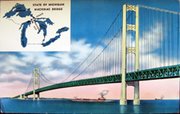
Sometimes travel brochures promise more than you find upon arrival at your destination. But I have found some interesting details to enhance a brief Fourth of July trip to the Thumb, as well as my general appreciation of our state.
From "Welcome to Vacationland 2007: Official Guide for the Blue Water Area":
Michigan leads the nation in number of state parks and campsites.
Michigan was the first state to establish roadside picnic tables.
No matter where you are in Michigan, you are within 85 miles of a Great Lake.
This year is Port Huron's Sesquicentennial. It was incorporated on February 4, 1857. Visit www.ph150.org for details.
The 83d annual Port Huron-Mackinac Island Yacht Race begins July 21st. The starting area for the race will be located on the west side of the shipping channel in lower Lake Huron approximately 4.5 nautical miles north of the Blue Water Bridges near the U.S. shore.
From "Lexington, Michigan 2007 Visitors Guide":
Lexington is 112 miles from Ann Arbor, 194 miles from Grand Rapids and 139 miles from Lansing.
Lexington was incorporated in 1855. Shingles were the currency in the early days of the settlement. One thousand dollars bought a barrel of flour and 20,000 shingles bought a barrel of pork.
From "Michigan Travel Ideas--Michigan's Official State Travel Guide":
Between South Haven and Ludington, there are 130 miles sugar-fine, sandy beaches on Lake Michigan.
South Haven will host the National Blueberry Festival August 9-12.
Seul Choix Point Lighthouse, 20 miles east of Manistique, has guided ships since 1892 and is the only working light left on northern Lake Michigan.
Get out and explore. Michigan is an amazing place.
Showing posts with label great lakes region. Show all posts
Showing posts with label great lakes region. Show all posts
Tuesday, July 3, 2007
Monday, June 25, 2007
Summer Means Tourism

Pure Michigan is upon us. That's the campaign promoted by Travel Michigan featuring broadcast media spots with Tim Allen at a cost of $8.7 million on out-of-state ads and $1.5 million in the state. (source)
So, how are we doing?

In March, the Michigan Travel Commission released the Michigan Tourism Strategic Plan, the product of a vast collaborative effort initiated in September of 2005.
From the Executive Summary:
"Michigan is primarily a regional tourism destination drawing about 70% of its business from Michigan residents and 20% from residents of adjacent states and Ontario. Its reliance on this regional tourism market is problematic both in the near term and the long run. The Michigan economy has been weak for several years and is projected to remain so for some time. Population growth in this region of the US is projected by the US Census Bureau to lag the rest of the country, which poses a long term threat to Michigan’s tourism industry."
So we have some challenges.
I spoke with George Zimmermann, Vice President of Travel Michigan. "We have traditionally marketed the state regionally for budget reasons. The current Travel Michigan budget is $15.6 million, and the promotion part of that is $13.2 million." About 80% of that is spent out of state and 20% in state. The main regional markets include: Chicago, Cleveland, Cincinnati, Indianapolis, Milwaukee and Ontario.

Good news for the immediate future: passport rules have been eased and the Canadian dollar is strong. Michigan saw improvement in May's unemployment figures in part due to 19,000 new hires in leisure and hospitality services mainly in northern counties.
But like the arts, tourism promotion endured a steady funding decline from 1990 to 2005. Zimmermann said,"In 1990 we had the seventh largest state tourism promotion budget and by 2005 we had dropped to 31st. We did get a reprieve when the 21st Century Jobs fund was created. That provided a one-time funding boost that brought us up to the $15.6 million level. So this year we're back up to 17th. But with the 2007 budget we're at the end of that money."
In addition to maintaining regional promotion efforts, the next big challenge is transforming Michigan from a regional tourism destination to a national destination and ultimately, a global one. Consensus among tourism professionals holds that Michigan can become a national and global destination.

But, given the likely shrinkage of the 70% stay-at-home tourism market, what is being done to grow the other 30%--in particular, the 10% coming from somewhere other than our region?
The May 2007 Travel Michigan Newsletter reports a recent initiative to reach German travelers:
"Travel writers from the North Rhine-Westphalia area of Germany recently toured Michigan to help promote a new KLM/Northwest Airlines direct-flight from Düsseldorf to Detroit. ...The writers represented publications with a combined circulation of over 2.8 million readers. The new direct flight, which begins service in early June, is expected to encourage more visitations through the Michigan gateway by German travelers, seeking a combination of exciting city experiences, active outdoor soft adventure and a more relaxed, freshwater Great Lakes holiday."
This program was part of regional promotion by Great Lakes of North America. Zimmermann said,"The one international effort we are involved in is a consortium of the Great Lakes States, called Great Lakes of North America. It’s been around for almost 20 years. The state tourism offices in Pennsylvania, Michigan, Ohio, Indiana, Illinois, Wisconsin, Minnesota, jointly fund regional promotion in Europe. It’s a way to have influence in the market. We are able to do promotions to get travel writers to come in and we work with tour operators to make sure they feature the Great Lakes in their catalogs and programs."
Zimmermann was very enthusiastic about recent performance of the Travel Michigan website. Michigan's tourism industry web site, www.michigan.org, is being tauted as busiest state tourism web site in the nation. "Our marketing strategy is to get consumers to go to the website, get more information there and then travel. So this is very encouraging," Zimmermann said.
What about 2008? "With 'Pure Michigan' we feel like we have a compelling campaign at this point, but what markets we can be active in next year will be 100% dependent on budget. That will determine if can we even maintain the six primary out-of-state regional markets. That will be strictly a financial decision. Once we know what our budget is we can figure out what to do with it,"he said.
But here's the bottom line--“Visitors spend about $17.5 billion annually, which employs 193,000 people statewide and contributes $971 million in state taxes.”
Tourism, it's Pure Michigan.


Thursday, June 21, 2007
The Long View on Climate and Levels in the Great Lakes
The Chicago Tribune is a great paper. Take some time to settle in with this well done piece.
From today's Great Lakes' past may offer clues on climate, an excerpt:
"During periods of low water that lasted until 2,000 years ago, a forest stood at the bottom of Duluth harbor and in parts of Lake Huron. Peat bogs stretched between what are now the Apostles Islands near Wisconsin. At a bay above Sault Ste. Marie, Mich., successive underwater ridges were a thriving forest when Leif Ericson landed in North America, and an active beach later in dry spells as recent as the 1700s. In Lake Michigan, salvage divers in the 1980s found a grove of sunken tree trunks 15 miles off Navy Pier that date back thousands of years.
Piecing together those clues, climate detectives suspect Lakes Superior, Michigan and Huron may have been lower than 20th Century historical averages in the 13th and 17th Centuries and much higher in the 16th Century as well as over the last 50 years."
Thank you, James Janega, for writing this article.
From today's Great Lakes' past may offer clues on climate, an excerpt:
"During periods of low water that lasted until 2,000 years ago, a forest stood at the bottom of Duluth harbor and in parts of Lake Huron. Peat bogs stretched between what are now the Apostles Islands near Wisconsin. At a bay above Sault Ste. Marie, Mich., successive underwater ridges were a thriving forest when Leif Ericson landed in North America, and an active beach later in dry spells as recent as the 1700s. In Lake Michigan, salvage divers in the 1980s found a grove of sunken tree trunks 15 miles off Navy Pier that date back thousands of years.
Piecing together those clues, climate detectives suspect Lakes Superior, Michigan and Huron may have been lower than 20th Century historical averages in the 13th and 17th Centuries and much higher in the 16th Century as well as over the last 50 years."
Thank you, James Janega, for writing this article.
Brookings Forum on the Future of Great Lakes Economy
Looking for something to do in D.C. next week? Consider attending a forum on the Future of Great Lakes Economy, Thursday, June 28, from 8:30 a.m. to 12 noon in the Falk Auditorium of the Brookings Institution. From the press release:
" On June 28, the Brookings Metropolitan Policy Program will host the first in a series of forums to highlight ways the federal government can help bolster the economic assets of the Great Lakes Region. Rep. Vernon Ehlers (R-Mich.), a longtime proponent of revitalizing the region, will provide opening remarks. This two-panel discussion also includes experts from the communities, universities, foundations and associations in the Great Lakes region. Panelists will discuss the innovative efforts currently underway to boost the economic competitiveness of the region, such as technology, innovation, and environmental stewardship; and will offer federal policy recommendations designed to foster the Great Lake Region's continued growth as a vital economic engine for the nation in the years ahead."
Participants include: Michigan State University President, Lou Anna Simon; Nature Conservancy, State Director in Michigan, Helen Taylor; George Kuper, President, Council of Great Lakes Industries (based in Ann Arbor).
" On June 28, the Brookings Metropolitan Policy Program will host the first in a series of forums to highlight ways the federal government can help bolster the economic assets of the Great Lakes Region. Rep. Vernon Ehlers (R-Mich.), a longtime proponent of revitalizing the region, will provide opening remarks. This two-panel discussion also includes experts from the communities, universities, foundations and associations in the Great Lakes region. Panelists will discuss the innovative efforts currently underway to boost the economic competitiveness of the region, such as technology, innovation, and environmental stewardship; and will offer federal policy recommendations designed to foster the Great Lake Region's continued growth as a vital economic engine for the nation in the years ahead."
Participants include: Michigan State University President, Lou Anna Simon; Nature Conservancy, State Director in Michigan, Helen Taylor; George Kuper, President, Council of Great Lakes Industries (based in Ann Arbor).
Tuesday, June 19, 2007
Great Lakes--Lower Levels Raising Concern
Visible by satellite--the earth's largest figure-ground study--the Great Lakes give shape to Michigan. The Great Lakes State is surrounded by 20% of the world's fresh surface water (source). Alaska is the only state with more coastline (we have 3,288 miles of it).
At the moment, a lot of people are worried about low lake levels and with reason. Lake Superior is at its lowest level since the Dust Bowl years. The Duluth News Tribune reports that for the first time in more than 30 years the 71-foot ship Winonah will not operate from Grand Portage to Isle Royale.
Sootoday.com reported a contentious public forum held on the Canadian side of the Soo last Thursday. It quotes Tom McAuley, engineering adviser to the IJC (International Joint Commission) and David Fay, Ontario manager of the Great Lakes St. Lawrence River Regulation Office for Environment Canada's Meteorological Services of Canada:
"For the past nine years, Lake Superior net basin supplies have been at a net loss," said Fay. "This means that more water is leaving the lake than is going in."
"It's climate change," he said. "Lake Superior is a very large lake and it hasn't frozen over in years."
McAuley and Fay agreed that more water is evaporating from the lake between the months of September and February in recent times than ever before in recorded history.
"The lowest level in the lake was in 1926 and we are just one centimeter above that right now," said weatherman Fay. "I expect it will drop below that by September this year."
Fay said he's seen credible models that predict catastrophic water loss in the lake over the next few years as well.
Alarming.
Cynthia Sellinger, hydrologist and Deputy Director at NOAA's Great Lakes Environmental Research Lab in Ann Arbor says,"The western end of Lake Superior has been in a severe drought since last June. Since 2003 parts of Minnesota, Wisconsin and Michigan have been in and out of conditions ranging from moderately dry to severe drought. Lake Superior supplies about 30% of the water to Lakes Michigan and Huron." Less water in Superior means less water flowing into Michigan and Huron. Lakes Erie and Ontario, currently higher than their longterm mean levels,"have gotten a lot of moisture from the Gulf of Mexico,"Sellinger said.
"The upper lakes get a much of their moisture from polar air masses and from the Pacific as well. But recently there has been less of that moisture than in previous years."
Travis Dahl, Chief, Water Hydrology Branch, U.S. Army Corps of Engineers Detroit Office said,"Since 1918, the record lows for Superior were set during the Dust Bowl, but the record lows for Lakes Michigan and Huron actually were set in the mid 1960s." A multi-continent severe drought was to blame.
I was looking for a comforting longterm perspective on the matter of lake levels. After all, a certain amount of fluctuation is normal and has been observed since records have been kept. The hydrologic cycle is a complex interplay of precipitation, evaporation, transpiration, percolation, runoff and outflows.
When asked point blank if there was anything she could say to assuage fears about the impact of falling lake levels, Sellinger said,"not really." Ouch.
"We've had a lot less moisture and more evaporation in the upper lakes. But the lower lakes have been receiving more precipitation from the Atlantic hurricane tracks. So you're getting a mixture of things affecting the region,"she said.
"Increased hurricane activity resulting from climate change will likely bring more moisture into the region of the lower lakes. You can't say that overall that global warming is going to suck the lakes dry, but they do respond to climatic events,"she said. Such events include the year-long severe drought affecting Superior right now, previous multi-continent severe droughts and ongoing events like increasing global air temperatures and ocean temperatures. (The Aral Sea disaster was brought on by human activities, namely massive river diversions.)
What does this mean for human activities? Shipping is already affected. As reported in yesterday's Lansing State Journal, Saginaw River traffic has slowed in part due to water levels. The Toronto Star reported last week, "
A multitude of government agencies--Canadian, U.S. and bi-national--collaborate to monitor and steward the Great Lakes. The lakes have always commanded our respect and humility. As vast as the lakes are, global changes will have an impact.
From the Great Lakes Atlas published by the U.S. EPA, Great Lakes National Program Office:
"Warmer climates mean increased evaporation from the lake surfaces and evapotranspiration from the land surface of the basin. This in turn will augment the percentage of precipitation that is returned to the atmosphere. Studies have shown that the resulting net basin supply, the amount of water contributed by each lake basin to the overall hydrologic system, will be decreased by 23 to 50 percent. The resulting decreases in average lake levels will be from half a metre to two metres, depending on the GCM [general circulation model] used."
Walk lightly, everyone.
(Since this was posted the Independent (UK) has published Climate change blamed as Superior shrinks, June 20, 2007)
At the moment, a lot of people are worried about low lake levels and with reason. Lake Superior is at its lowest level since the Dust Bowl years. The Duluth News Tribune reports that for the first time in more than 30 years the 71-foot ship Winonah will not operate from Grand Portage to Isle Royale.
Sootoday.com reported a contentious public forum held on the Canadian side of the Soo last Thursday. It quotes Tom McAuley, engineering adviser to the IJC (International Joint Commission) and David Fay, Ontario manager of the Great Lakes St. Lawrence River Regulation Office for Environment Canada's Meteorological Services of Canada:
"For the past nine years, Lake Superior net basin supplies have been at a net loss," said Fay. "This means that more water is leaving the lake than is going in."
"It's climate change," he said. "Lake Superior is a very large lake and it hasn't frozen over in years."
McAuley and Fay agreed that more water is evaporating from the lake between the months of September and February in recent times than ever before in recorded history.
"The lowest level in the lake was in 1926 and we are just one centimeter above that right now," said weatherman Fay. "I expect it will drop below that by September this year."
Fay said he's seen credible models that predict catastrophic water loss in the lake over the next few years as well.
Alarming.
Cynthia Sellinger, hydrologist and Deputy Director at NOAA's Great Lakes Environmental Research Lab in Ann Arbor says,"The western end of Lake Superior has been in a severe drought since last June. Since 2003 parts of Minnesota, Wisconsin and Michigan have been in and out of conditions ranging from moderately dry to severe drought. Lake Superior supplies about 30% of the water to Lakes Michigan and Huron." Less water in Superior means less water flowing into Michigan and Huron. Lakes Erie and Ontario, currently higher than their longterm mean levels,"have gotten a lot of moisture from the Gulf of Mexico,"Sellinger said.
"The upper lakes get a much of their moisture from polar air masses and from the Pacific as well. But recently there has been less of that moisture than in previous years."
Travis Dahl, Chief, Water Hydrology Branch, U.S. Army Corps of Engineers Detroit Office said,"Since 1918, the record lows for Superior were set during the Dust Bowl, but the record lows for Lakes Michigan and Huron actually were set in the mid 1960s." A multi-continent severe drought was to blame.
I was looking for a comforting longterm perspective on the matter of lake levels. After all, a certain amount of fluctuation is normal and has been observed since records have been kept. The hydrologic cycle is a complex interplay of precipitation, evaporation, transpiration, percolation, runoff and outflows.
When asked point blank if there was anything she could say to assuage fears about the impact of falling lake levels, Sellinger said,"not really." Ouch.
"We've had a lot less moisture and more evaporation in the upper lakes. But the lower lakes have been receiving more precipitation from the Atlantic hurricane tracks. So you're getting a mixture of things affecting the region,"she said.
"Increased hurricane activity resulting from climate change will likely bring more moisture into the region of the lower lakes. You can't say that overall that global warming is going to suck the lakes dry, but they do respond to climatic events,"she said. Such events include the year-long severe drought affecting Superior right now, previous multi-continent severe droughts and ongoing events like increasing global air temperatures and ocean temperatures. (The Aral Sea disaster was brought on by human activities, namely massive river diversions.)
What does this mean for human activities? Shipping is already affected. As reported in yesterday's Lansing State Journal, Saginaw River traffic has slowed in part due to water levels. The Toronto Star reported last week, "
A multitude of government agencies--Canadian, U.S. and bi-national--collaborate to monitor and steward the Great Lakes. The lakes have always commanded our respect and humility. As vast as the lakes are, global changes will have an impact.
From the Great Lakes Atlas published by the U.S. EPA, Great Lakes National Program Office:
"Warmer climates mean increased evaporation from the lake surfaces and evapotranspiration from the land surface of the basin. This in turn will augment the percentage of precipitation that is returned to the atmosphere. Studies have shown that the resulting net basin supply, the amount of water contributed by each lake basin to the overall hydrologic system, will be decreased by 23 to 50 percent. The resulting decreases in average lake levels will be from half a metre to two metres, depending on the GCM [general circulation model] used."
Walk lightly, everyone.
(Since this was posted the Independent (UK) has published Climate change blamed as Superior shrinks, June 20, 2007)
Thursday, May 24, 2007
Subscribe to:
Posts (Atom)